AN EXPLORATION INTO THE STRIKING SIMILARITIES BETWEEN BJÖRK AND HIERONYMUS BOSCH. IS SHE THE MODERN DAY BOSCH?
To step into the world of Björk is to abandon the sterile, modern pop landscapes of today and trek into something ancient, chaotic, organic, and alive. For over three decades, the Icelandic singer has treated the human body not as a template for commercial, mainstream beauty, but as an unstable canvas for surrealism. Where the rest of the world looks forward to a clean yet clinical future, Björk looks to the past. Specifically, the Northern renaissance.
Look closely at her evolution and you’ll notice that the shadow of one history-defining master becomes inescapable: Hieronymus Bosch
Centuries before Björk even began to make the music we know today, Bosch was busy painting the ultimate paradox on wood panels. His masterpieces, most famously The Garden of Earthy Delights, were sprawling, maximalist tapestries filled with human desire, divine punishment, and biological mutations. It was a world where glass spheres grew from the soil, birds ate humans, while sitting on thrones, 11 people shared a single berry, and the boundaries between flesh, flora, and machine dissolved entirely.
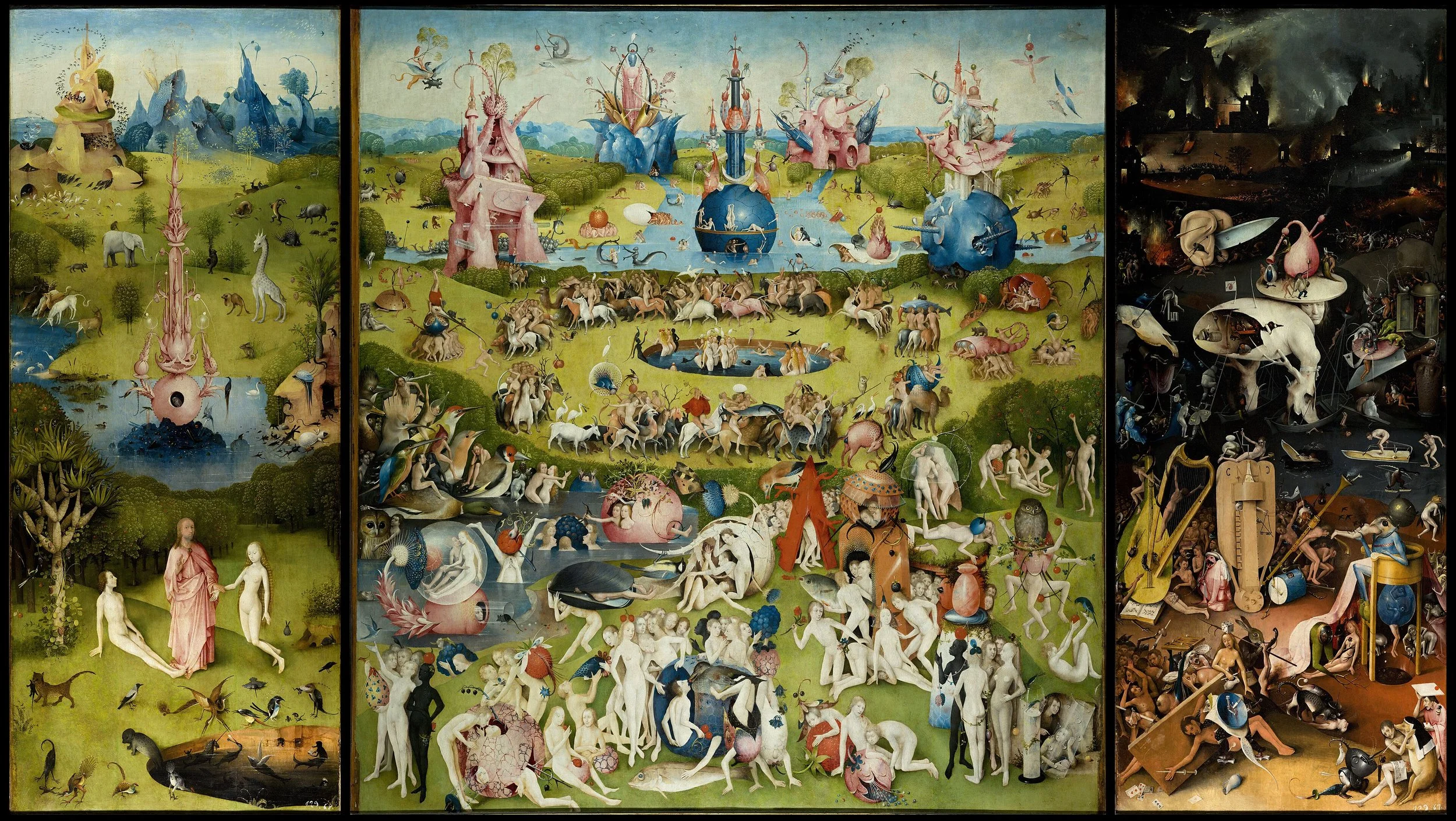
Hieronymus Bosch, The Garden of Earthly Delights, (c. 1490-1500). Oil on oak panel, Height: 185.8 cm; Width of the wing: 76.5 cm; Width of the central panel: 172.5 cm. Museo del Prado, Madrid. Image Courtesy of Wikimedia Commons.
Today, who better to embody Bosch in modern times than Björk?
Where this connection becomes apparent is not through her lyrics, but by the thread of her garments. Björk does not wear fashion; she wears architecture, anatomy, and flora. Take a look at her partnerships with legends like the late Alexander McQueen, an artist who shared her appetite for the grotesque and the sublime. Together, they engineered a style unknown to the present, fusing the organic textures of hair, feathers, and bone with sharp silhouettes. A direct echo of Bosch’s half-human, half-instrument hybrids that filled his hellscapes.
Take a look at her recent Utopia and Fossora eras, where this surrealism has reached its literal peak. Collaborating with embroiderer and mask-maker James Merry, Björk has abandoned the traditional human silhouette, opting instead for mutated orchids sprouting from her cheekbones and fungal gills unfolding from her neckline. When she stands in front of the camera, the effect is dizzying.
“We are no longer looking at clothes; we are looking at a masterclass in evolution that has gone beautifully and unexpectedly right.”
By merging the hyper avant-garde with the textures of the earth, Björk pulls her listeners out of the 21st century into a timeless mural. Quite literally timeless–she’s taking us to both the future and the past.
“She reminds us that fashion, at its highest peak, is not about what is wearable. It’s about constructing a world so vividly strange that the viewer has no choice but to step inside, lose themselves, and marvel at Björk’s beautifully terrifying garden.”
